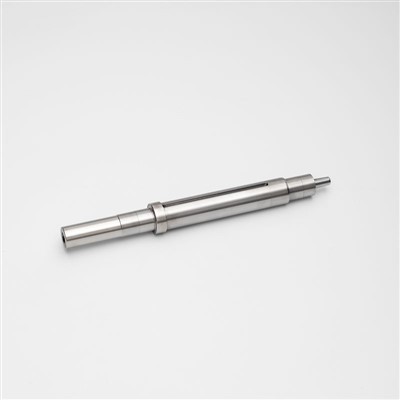
As a seasoned supplier of shaft parts, I’ve witnessed firsthand the pivotal role that axial stiffness plays in the performance of these components. Axial stiffness refers to the ability of a shaft to resist deformation under axial loads, which is crucial for ensuring the precision and reliability of machinery. In this blog, I will delve into the various factors that affect the axial stiffness of shaft parts, providing insights that can help engineers and manufacturers make informed decisions when selecting and designing shafts. Shaft Parts

Material Properties
The material of a shaft is one of the primary factors influencing its axial stiffness. Different materials have distinct mechanical properties, such as Young’s modulus, which is a measure of a material’s stiffness. For instance, steel is a commonly used material for shaft parts due to its high Young’s modulus, which typically ranges from 190 to 210 GPa. This high modulus allows steel shafts to withstand significant axial loads with minimal deformation.
On the other hand, materials like aluminum have a lower Young’s modulus, around 70 GPa. While aluminum shafts are lighter and more corrosion – resistant, they offer less axial stiffness compared to steel shafts. Therefore, when the application requires high axial stiffness, steel is often the preferred material.
Another aspect of material properties is the material’s density. Although density does not directly affect axial stiffness, it can influence the overall weight of the shaft. In applications where weight is a critical factor, such as aerospace or automotive industries, a balance must be struck between the desired axial stiffness and the weight of the shaft.
Shaft Geometry
The geometry of a shaft has a profound impact on its axial stiffness. The cross – sectional area is a key geometric parameter. According to Hooke’s law, the axial stiffness (k) of a shaft is directly proportional to the cross – sectional area (A) and Young’s modulus (E) and inversely proportional to the length (L) of the shaft, expressed by the formula (k=\frac{AE}{L}).
A larger cross – sectional area provides more material to resist axial deformation, thus increasing the axial stiffness. For example, a solid shaft with a larger diameter will have a higher axial stiffness than a shaft with a smaller diameter. However, increasing the cross – sectional area also increases the weight and cost of the shaft.
The length of the shaft is another important geometric factor. As the length of the shaft increases, its axial stiffness decreases. This is because a longer shaft has more material that can deform under axial loads. In applications where high axial stiffness is required, shorter shafts are often preferred.
In addition to the cross – sectional area and length, the shape of the cross – section can also affect axial stiffness. For example, a hollow shaft can have a different axial stiffness compared to a solid shaft of the same outer diameter. Hollow shafts can be designed to optimize the distribution of material, providing a good balance between weight and axial stiffness.
Manufacturing Processes
The manufacturing processes used to produce shaft parts can also influence their axial stiffness. Precision machining is essential for ensuring the correct dimensions and surface finish of the shaft. Any deviations in the dimensions, such as an uneven cross – sectional area or a non – straight shaft, can reduce the axial stiffness.
Heat treatment is another important manufacturing process. Heat treatment can alter the material’s microstructure, which in turn affects its mechanical properties, including Young’s modulus. For example, quenching and tempering of steel can increase its hardness and strength, which may also improve its axial stiffness.
Surface treatment, such as nitriding or plating, can enhance the surface properties of the shaft. A hard and smooth surface can reduce friction and wear, which is beneficial for maintaining the axial stiffness over time. However, if the surface treatment is not applied correctly, it may introduce residual stresses in the shaft, which can have a negative impact on its axial stiffness.
Assembly and Support Conditions
The way a shaft is assembled and supported in a system can significantly affect its axial stiffness. The type of bearings used to support the shaft is a critical factor. Different types of bearings, such as ball bearings, roller bearings, and plain bearings, have different stiffness characteristics.
For example, angular contact ball bearings can provide high axial stiffness and are often used in applications where precise axial positioning is required. In contrast, deep – groove ball bearings are more suitable for applications with lower axial loads.
The pre – loading of bearings also plays an important role. Pre – loading is the process of applying an initial load to the bearings to eliminate clearance and increase stiffness. A properly pre – loaded bearing can improve the axial stiffness of the shaft system.
The alignment of the shaft and its supporting components is another crucial aspect. Misalignment can cause uneven loading on the shaft, leading to increased deformation and reduced axial stiffness. Therefore, proper alignment during assembly is essential for maintaining the axial stiffness of the shaft.
External Loads and Environmental Conditions
External loads applied to the shaft can have a direct impact on its axial stiffness. Static loads, such as the weight of the components attached to the shaft, can cause permanent deformation if they exceed the shaft’s axial stiffness capacity. Dynamic loads, such as vibrations and shocks, can also affect the shaft’s performance.
Vibrations can lead to fatigue failure and reduced axial stiffness over time. To mitigate the effects of vibrations, damping mechanisms can be incorporated into the shaft system. Shocks, on the other hand, can cause sudden and large – scale deformation, which may damage the shaft and reduce its axial stiffness.
Environmental conditions, such as temperature and humidity, can also influence the axial stiffness of shaft parts. High temperatures can cause thermal expansion of the shaft, which may change its dimensions and reduce its axial stiffness. In addition, high humidity can lead to corrosion, which can weaken the shaft and reduce its axial stiffness.
In conclusion, the axial stiffness of shaft parts is affected by a multitude of factors, including material properties, shaft geometry, manufacturing processes, assembly and support conditions, as well as external loads and environmental conditions. As a shaft parts supplier, I understand the importance of considering these factors when providing high – quality shaft solutions to our customers.
Parts Processing If you are in the market for shaft parts and need to ensure optimal axial stiffness for your application, I encourage you to reach out to us. Our team of experts can work with you to select the right materials, design the appropriate shaft geometry, and recommend the best manufacturing and assembly processes to meet your specific requirements. Let’s start a conversation about how we can provide you with the perfect shaft parts for your project.
References
- Budynas, R. G., & Nisbett, J. K. (2011). Shigley’s Mechanical Engineering Design. McGraw – Hill.
- Juvinall, R. C., & Marshek, K. M. (2006). Fundamentals of Machine Component Design. Wiley.
- Shigley, J. E., & Mischke, C. R. (2001). Mechanical Engineering Design. McGraw – Hill.
Taizhou Liuhuan Machinery Co., Ltd.
As one of the most professional shaft parts manufacturers and suppliers in China, we’re featured by quality products and good service. Please rest assured to buy customized shaft parts made in China here from our factory. For quotation, contact us now.
Address: Xinyuan Industrial Zone, Damaiyu Street, Yuhuan City, Zhejiang Province,China
E-mail: tzlhmachining@gmail.com
WebSite: https://www.tzlhmachining.com/
